When a Toothbrush Becomes a Technological Marvel
6 September 2026
Of all the products being reimagined right now, a toothbrush was the last one I expected to see on that list.
And yet James Dyson just pulled off something unthinkable: he took a $3 commodity object and gave it its own camera and its own AI brain.
As I read more about it, I couldn’t help but note these points that show what a technological marvel it is.
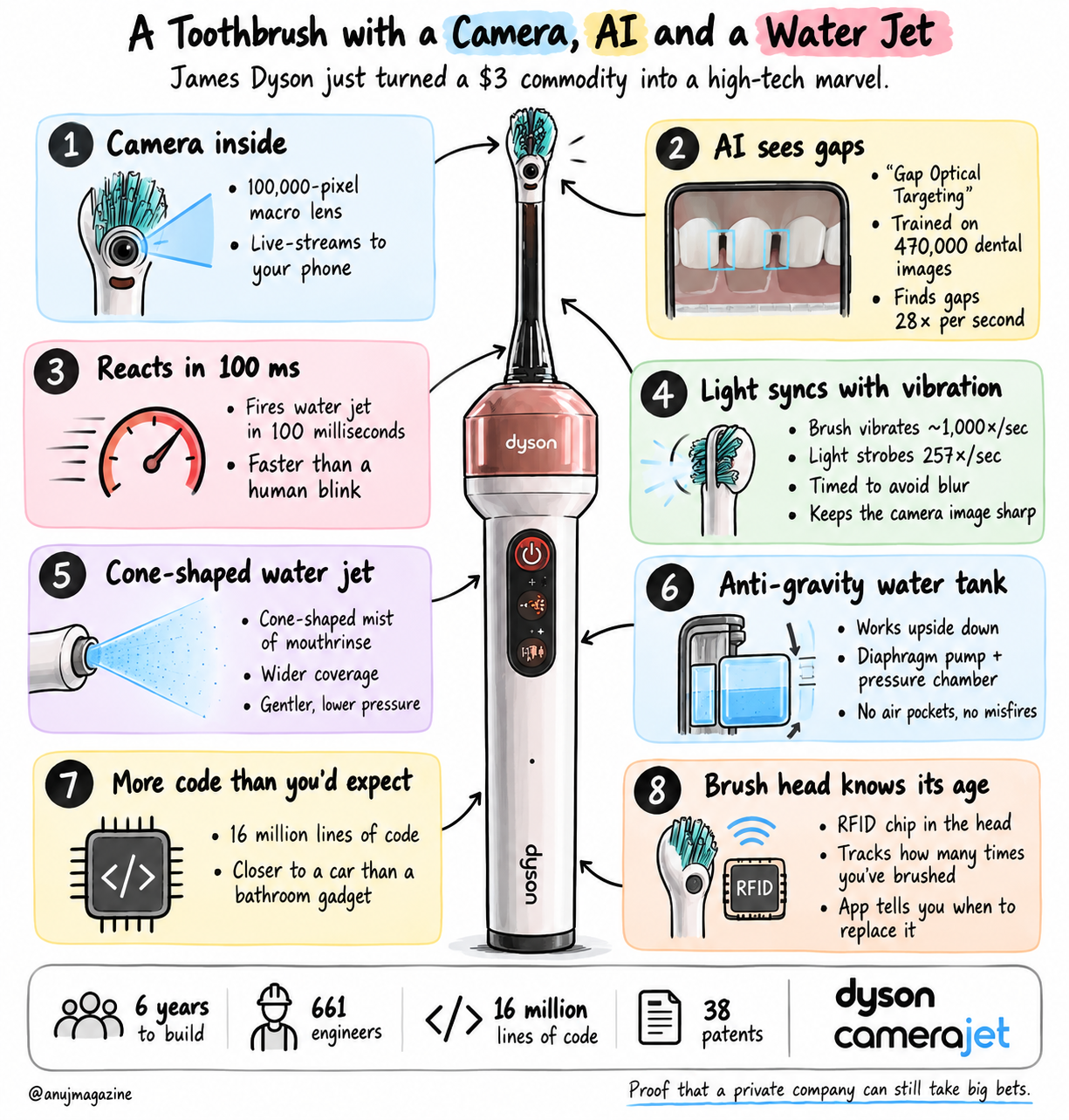
Eight details that caught my attention
-
A real camera inside your mouth. A 100,000-pixel macro lens sits right below the brush head and live-streams what it sees to your phone, essentially turning your toothbrush into a tiny dental endoscope.
-
It “sees” gaps between your teeth 28 times a second. An AI system called Gap Optical Targeting was trained on 470,000 dental images to recognise the dark gaps between teeth in real time, somewhat like a self-driving car recognising lane markings.
-
It reacts in 100 milliseconds. That’s faster than a human blink. When the camera spots a gap, the brush can decide to fire a water jet at it almost instantly.
-
The light blinks in sync with the vibration, on purpose. The brush vibrates close to 1,000 times a second, which would normally blur a camera image. Dyson strobes the internal light at 257 times a second, timed around the vibrations to help keep the picture sharp while the brush is buzzing.
-
It floss-jets through a cone, not a needle. Instead of the thin needle-jet used in water flossers, CameraJet sprays a cone-shaped mist of mouthrinse to cover a wider area between teeth with a gentler, lower-pressure blast.
-
The water tank works upside down. An “anti-gravity” tank uses a diaphragm pump and pressure chamber so it can operate at different angles without developing air pockets or misfiring.
-
There’s more code in it than you would expect from a toothbrush. Dyson reports 16 million lines of code across the system, a surprising amount for a bathroom gadget.
-
The brush head knows its own age. An RFID chip embedded in the head tracks use and tells the app when it’s time to replace it, rather than relying only on a three-month guess.
It took Dyson six years, 661 engineers, 16 million lines of code and 38 patents to get a toothbrush to this point.
More than anything, this is what a private company can still do that a public one mostly can’t: spend six years and countless failures on a toothbrush nobody was asking for, because there’s no quarterly call where you have to explain why.
References
- Dyson: Introducing CameraJet
- TechRadar: Dyson CameraJet review
- DesignRush: Dyson AI toothbrush CameraJet