How People Really Use AI: The Hidden Story
5 September 2026
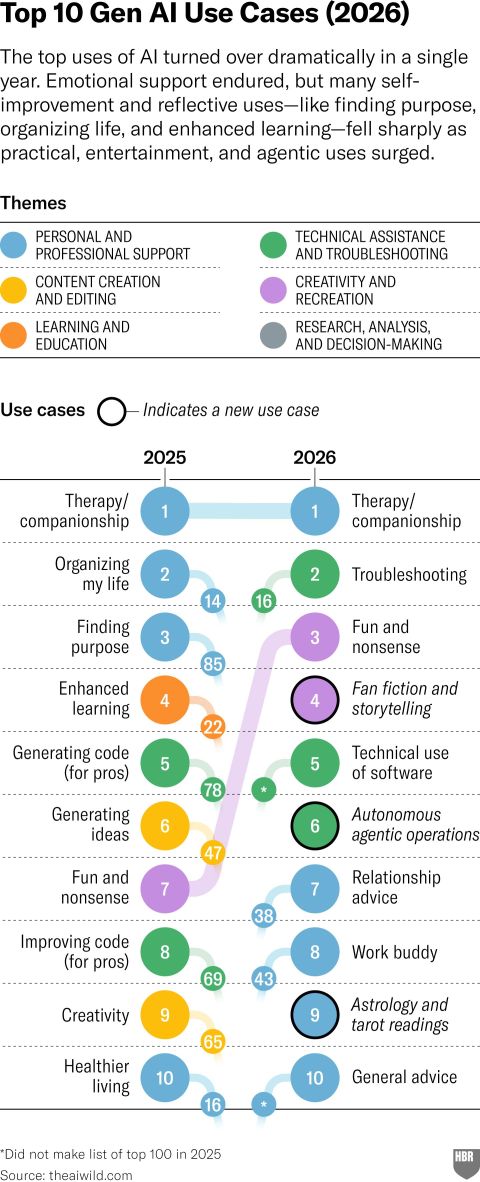
For the last three years, Harvard Business Review has published an “AI in the Wild” study, looking at how people are using AI that year.
A few random notes as I read this.
1. Fun and nonsense is now a major use case
More interesting this year is a category listed at #3: Fun and nonsense.
“Fun and nonsense” is the category the researchers use for AI activity with no productive or therapeutic purpose. It’s entertainment, novelty or simply killing time.
Examples discussed around the study include:
- Fake reality-TV content: prompting AI to invent fictional show scenes and drama between made-up characters.
- Robot tarot and astrology: asking chatbots for readings, horoscopes or fortune-telling.
- Short, inane videos: AI-generated clips that are strange or funny enough to share, without much narrative purpose.
2. Therapy and companionship lead again
The number-one use case, for the second year running, is therapy and companionship.
3. Business benefits are often incremental
On the business side, the authors are candid that most deployment is producing “marginal rather than game-changing benefits, so far.”
One exception they highlight is AI-personalised email campaigns, with reported 20–30% conversion lifts.
They also introduce the term “thinkslop”: lazy, approximate thinking that appears when people delegate not only execution to AI, but the thinking that should have happened before it.
The limitation worth remembering
It’s fun to read such analysis, but like every study, this one has limitations.
The dataset is built from people who chose to post publicly about their AI use. That can overrepresent uses people are comfortable sharing, such as therapy conversations, funny outputs and creative experiments.
It can also underrepresent uses people would rather keep private: cutting corners at work, having AI write something they’ll claim as their own, or anything that could make them look lazy or put their job at risk.
Which means the most important AI use case in your organisation right now is probably the one nobody’s posted about.
Reference