Tejaswin Shankar: A Comeback Beyond Medals
14 August 2026
The Commonwealth Games in Glasgow have ended, and like every big multi-sport event, most of it will fade from memory within a week: the medal tallies, the schedules, the constant scroll of results.
But some performances stay with you longer than the rest. Not necessarily because of what happened on the field, but because of what you learn happened before it.
I wanted to write about a few of these over the coming days, and the first one is Tejaswin Shankar’s.
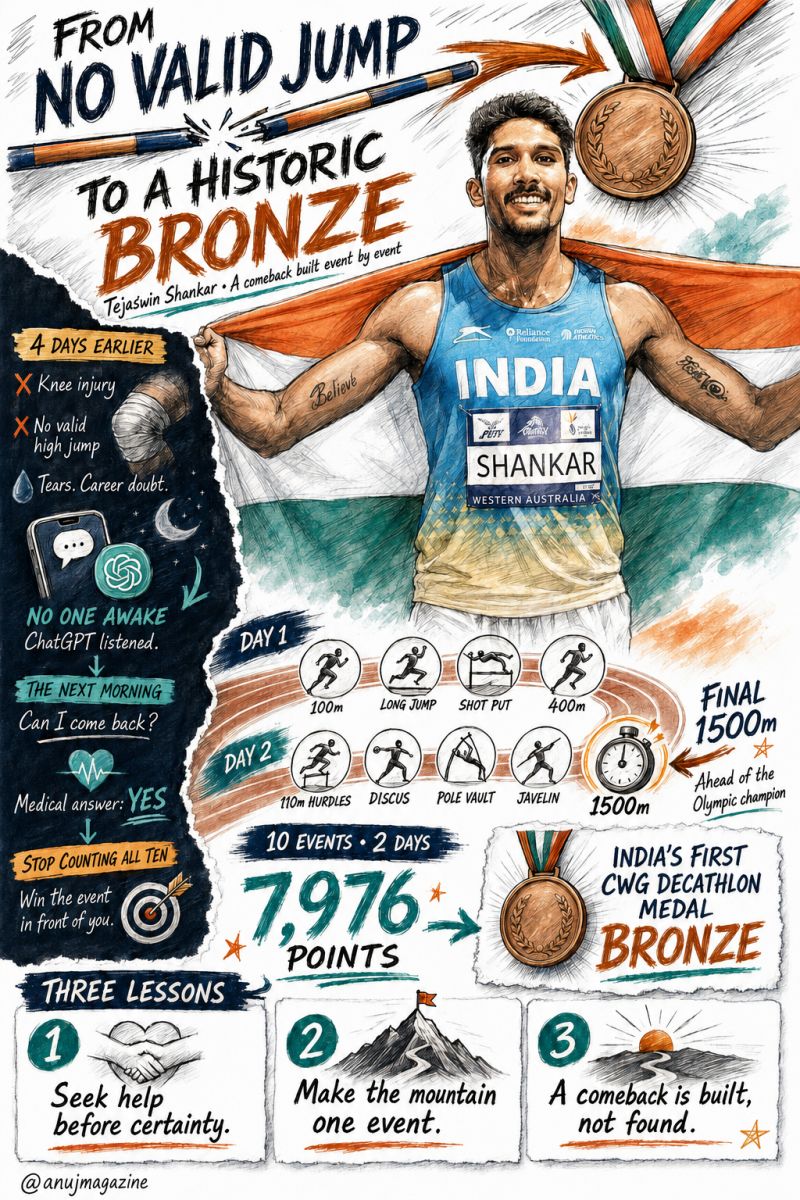
Shankar won India’s first-ever Commonwealth Games medal in the decathlon, a bronze with 7,976 points, behind Grenada’s Lindon Victor and Canada’s Damian Warner, the reigning Olympic champion in the event.
Ten events. Two days.
Worth pausing on what the decathlon actually asks of a body:
- Ten disciplines across two days: sprints, jumps, throws, hurdles, and a middle-distance race at the very end when everything is already spent. No room to specialise, and nowhere to hide a weakness.
- It is widely considered one of the most punishing tests in athletics because it rewards durability as much as talent. You cannot peak for one event and coast through the rest.
- In the final 1500m, run on legs that had already been through nine other events, Shankar actually finished ahead of Warner.
On paper, it reads like a clean story of grit and a well-timed peak.
It wasn’t.
Four days before the medal
Four days before that bronze, Shankar was in the high jump final, nursing a knee injury. He could not register a single valid jump.
He left the stadium in tears.
That night, back in his hotel room, alone, he was not thinking about strategy or splits or where he would place in the decathlon. He was genuinely unsure whether his career as an athlete was over.
He has since spoken about talking it through with ChatGPT that night, simply because there was no one else awake to talk to.
What actually turned things around was far more human.
The next morning, he found recovery specialist Wayne Lombard and asked him one direct question: Can I come back?
He got a yes, backed by a medical opinion that pain management would not risk further damage to the knee.
He scrapped whatever plan he had walked in with. On advice from fellow athlete Murali Sreeshankar to stop thinking about the whole decathlon and just get through the event in front of him, he did exactly that.
One event at a time
What followed is the part that is easy to skip past when you read it as a results line.
Less than 24 hours after being unable to land a single valid jump, on a knee that had not healed, Shankar competed across the decathlon’s demanding events over two days.
He sprinted, threw, vaulted, and ran the 1500m fast enough to beat an Olympic champion.
And he walked away with a medal no Indian decathlete had ever won.
Completely at a loss for words to describe what Tejaswin achieved.
Salute, Tejaswin Shankar.
References
- Olympics.com: Tejaswin Shankar’s Commonwealth Games decathlon bronze and reaction
- Khel Now: Tejaswin Shankar’s Commonwealth Games decathlon bronze