AI-Generated Content Is Getting an Invisible Signature
12 August 2026
An interesting feature addition by Anthropic.
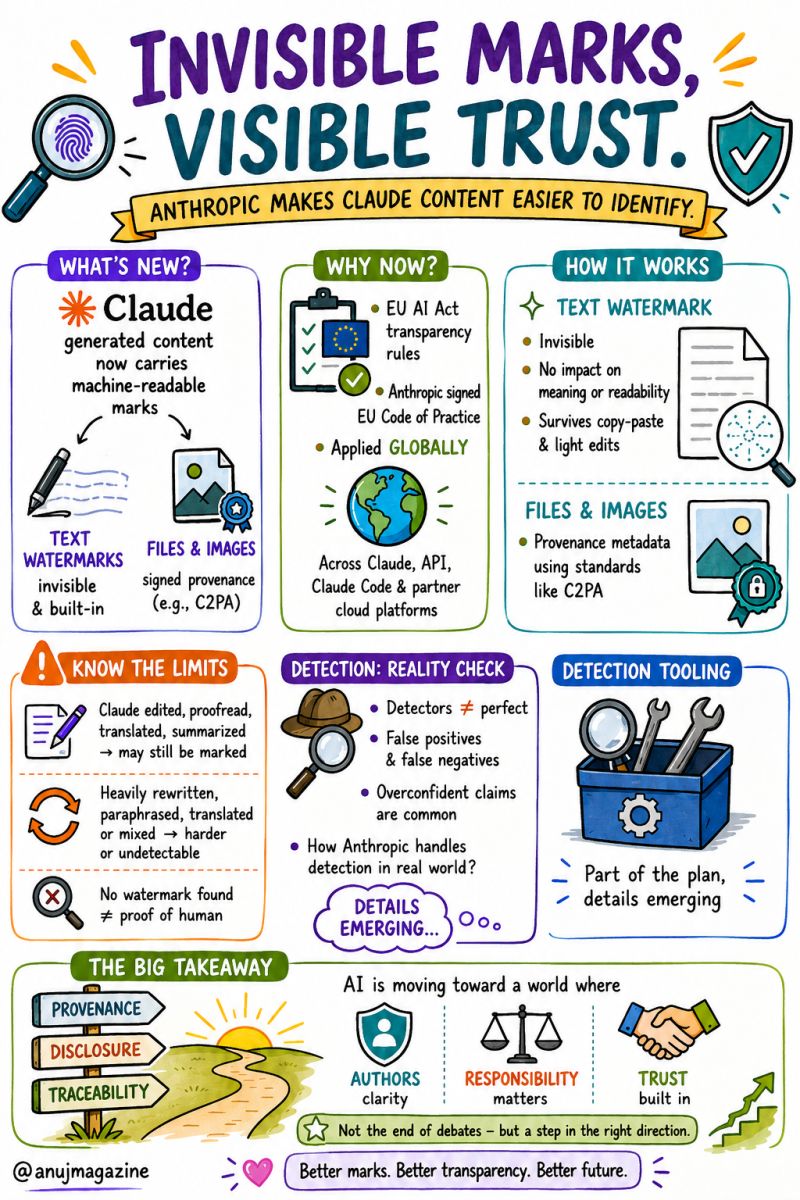
It recently announced that Claude-generated content will start carrying machine-readable marks: invisible watermarks for text, and signed provenance metadata for supported files and images.
In simple terms, the idea is that content produced by Claude should become easier to identify later, even if it has been copied elsewhere.
Why now?
The reason this is happening now is largely regulatory.
The EU AI Act’s transparency requirements are coming into force, and Anthropic has signed the EU Code of Practice on marking and labelling AI-generated content.
Interestingly, this is not being limited to EU users. Anthropic says the marking will apply globally across supported Claude models and products, including Claude, the API, Claude Code and partner cloud platforms.
How the marking works
For text, the watermark is supposed to be imperceptible. You will not see a label, symbol or obvious pattern in the writing.
Anthropic says it should not affect meaning, readability or quality. Because the mark is part of the text itself, it may survive copy-paste and some light edits.
For files and images, the approach is more like provenance metadata, using standards such as C2PA where supported.
The limitations matter
A watermark is not the same as proof that a piece was entirely written by AI.
If Claude edited, proofread, translated or summarised human writing, the output may still carry a mark.
On the other hand, if text is heavily rewritten, translated, paraphrased or mixed with other writing, the watermark may become harder or impossible to detect.
And if no watermark is found, that does not prove the content is human-written.
This matters because AI detection has never been a very accurate or settled area. Many detectors have struggled with false positives, false negatives and overconfident claims.
It remains to be seen how Anthropic tackles detection in practice and how reliable these tools become outside controlled settings.
Detection tooling appears to be part of the plan, but the details are still emerging.
A step toward traceability
The bigger takeaway is that AI is moving from “generate anything, anywhere” toward a world where provenance, disclosure and traceability become part of the infrastructure.
This will not end debates about authorship, plagiarism, synthetic media or trust.
But it seems like a small step in the right direction.
References
- Anthropic: How Claude marks AI-generated content
- European Commission: Code of Practice on marking and labelling AI-generated content