You Need to Own Your Context in the Age of AI
1 November 2026
You Need to Own Your Context in the Age of AI
The more AI knows about you, the more useful it becomes. But who benefits from everything it learns?
I recently read an interesting article by Dharmesh Shah, co-founder and CTO of HubSpot, in his AI newsletter. He raised a question that I think deserves more attention as we increasingly begin to rely on AI assistants in our everyday lives.
Who owns the context that AI builds about us?
It is an interesting question because much of the conversation about AI assistants today is focused on what they can do. How well they can reason, which applications they can connect to, how many tasks they can complete independently, and whether they can proactively help us without waiting for instructions.
But there is another dimension to their usefulness that is becoming increasingly important: how much they know about us.
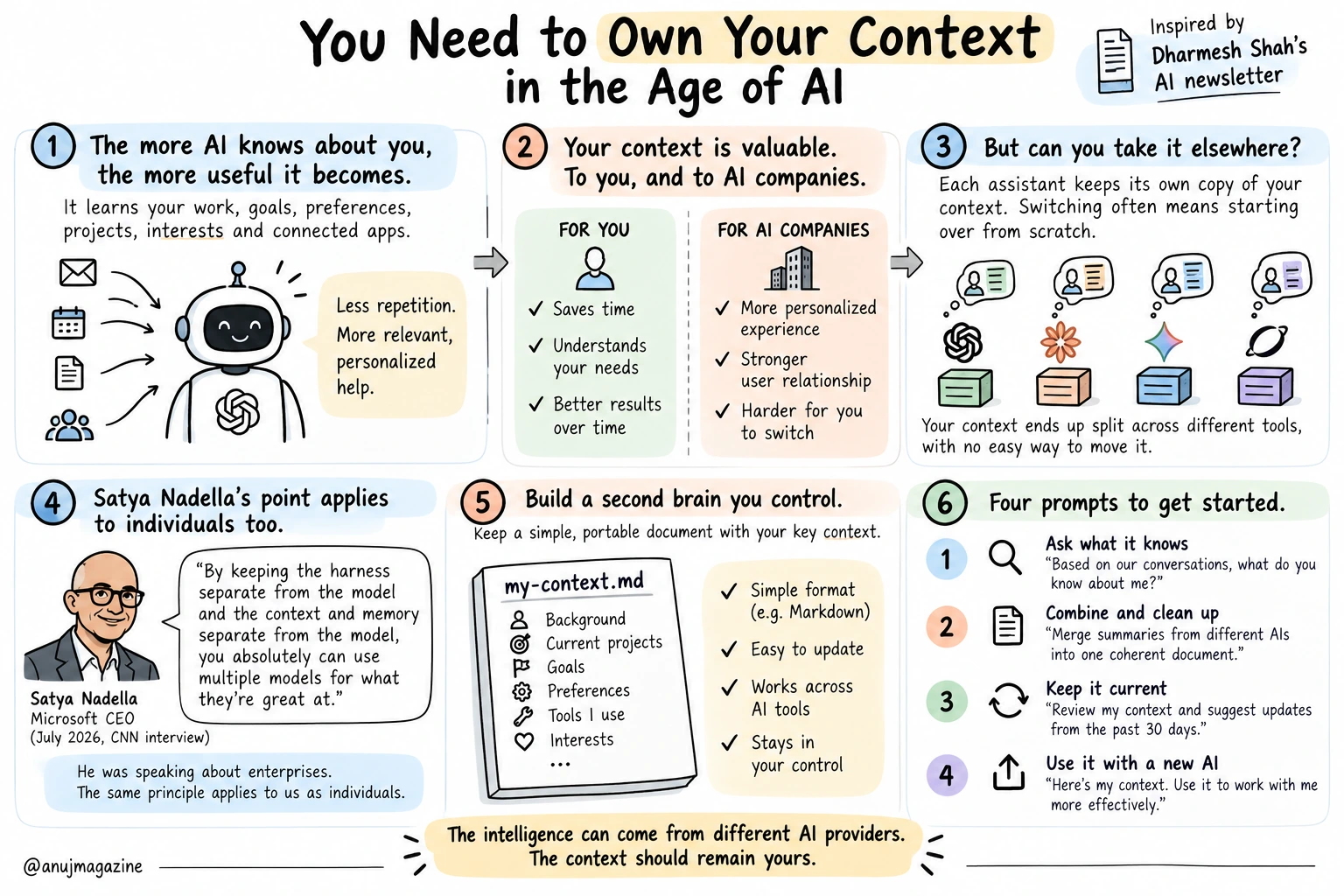
The more AI knows about you, the more useful it becomes. For you, and for AI companies.
Think about how you interact with an AI assistant when you first start using it.
You explain what you do, describe the project you are working on, provide background information, clarify your preferences, and sometimes correct its understanding of what you actually want.
Over time, some of that repetition begins to disappear.
The assistant may remember how you like to write, what projects you are involved in, which subjects interest you, what you have been working on recently, and how you prefer information to be presented.
With access to connected applications, it may also be able to retrieve information from your emails, calendar, documents and other systems, subject to the permissions you provide.
This is a meaningful change from the early days of generative AI, when every conversation often felt like starting from scratch.
The better assistants become at remembering and retrieving relevant context, the less effort we need to spend explaining ourselves.
But there is another side to this relationship worth thinking about.
The more an AI assistant knows about you, the more useful it becomes to you. But that accumulated knowledge can also become increasingly valuable to the company providing the assistant.
It helps the company deliver a more personalized experience, build a stronger relationship with its users, and potentially makes switching to another AI assistant more difficult.
So while you are investing time in teaching AI about yourself, you are also helping build an asset that may primarily remain under someone else’s control.
The value of your context grows for both sides. But who actually owns it?
Your AI assistant may know you well. But can you take that knowledge elsewhere?
Imagine you have been using one AI assistant for several months.
It has learned quite a bit about your work, preferences, ongoing projects and interests. You have invested considerable time in helping it understand you.
Now imagine another AI company releases a substantially better assistant, or perhaps one that is particularly good at a task you care about.
You want to try it.
But the new assistant doesn’t know you.
You may need to explain your background, preferences, projects and working habits all over again.
Meanwhile, your original assistant continues to hold valuable context that may not be easily transferable.
As Dharmesh points out in his newsletter, we are spending time teaching these systems about ourselves without necessarily creating an asset that we control.
And this becomes particularly important when we use multiple AI tools.
One assistant might understand our writing preferences. Another might know about our coding projects. A third might have useful context about our research or professional work.
Each holds a different part of the picture, and there may be no straightforward way to bring everything together.
We are accumulating context, but not necessarily owning it.
Satya Nadella’s argument about enterprise context applies to individuals too
Microsoft CEO Satya Nadella has also discussed the importance of keeping an organization’s context and memory separate from the underlying AI models.
In a July 2026 interview with CNN, he made an interesting observation:
“By keeping the harness separate from the model and the context and memory separate from the model, you absolutely can use multiple models for what they’re great at.”
Although Nadella was speaking about enterprises, I think the principle extends to individuals.
AI models provide general intelligence and capabilities. But the information that makes those capabilities useful in a particular organization comes from its own systems, processes, relationships, decisions and accumulated knowledge.
A model may be replaceable. The organization’s accumulated context is much harder to replace.
I think the same principle applies to individuals.
Our professional experience, the projects we have worked on, our ideas, decisions, interests, preferences and the things we have learned over time represent a growing body of personal context.
As we use AI more frequently, that context becomes increasingly useful.
It helps AI understand not just what we are asking, but why we are asking it, what we have tried before, and what a useful answer might look like for us.
The AI model may change. Your context should travel with you.
This doesn’t mean every conversation needs to be preserved, or that we should collect every piece of information about ourselves.
It means being more deliberate about retaining the knowledge that makes AI useful to us.
Building a second brain that you control
Dharmesh advocates maintaining your own second brain, a collection of personal knowledge and context that exists independently of any particular AI assistant.
I like this idea because it doesn’t require sophisticated technology.
You can start with a simple document.
It could contain information about your professional background, ongoing projects, important decisions, personal interests, communication preferences, and recurring ways of working.
You can maintain it in a Markdown file, a Google Doc, or another format that is easy to access, edit and move.
Markdown is particularly useful because it is a simple text-based format that can be read by many applications and AI tools.
The important point is not which application you choose.
The important point is that the context remains accessible and under your control.
And you don’t need to create this document entirely from scratch. Your existing AI assistants can help you build it.
Four practical prompts to get started
Here are four prompts you can try with the AI assistants you already use.
1. Ask AI what it knows about you
Start with ChatGPT, Claude, Gemini or whichever assistants you have been using regularly.
Prompt:
Based on our previous conversations and any memory available to you, create a structured document summarizing what you know about me.
Include:
- My professional background and areas of interest
- Projects and goals I am currently working on
- Important preferences about how I communicate and work
- Tools and applications I frequently use
- Recurring themes in my questions and decisions
- Things I prefer you to avoid
Separate confirmed information from reasonable inferences. Do not invent missing details. Identify anything that may be outdated or needs my confirmation.
The resulting document may surprise you. Depending on the assistant and its memory settings, it might contain useful details you had forgotten sharing.
It may also contain inaccuracies, so treat it as a first draft rather than an authoritative record.
2. Consolidate your context into one document
If you use multiple assistants, repeat the first exercise with each of them and bring the results together.
Prompt:
I am providing summaries of my background, preferences and projects generated by different AI assistants.
Combine them into one coherent personal context document.
Remove duplication, identify contradictions, and distinguish current information from historical information.
Organize the document into clear sections that another AI assistant could easily understand.
Do not resolve conflicting information by guessing. Flag anything that needs my review.
Produce the final document in Markdown format.
You now have the beginnings of a portable context document.
You might call it about-me.md, my-context.md or simply My AI Context.
3. Keep your context current
A second brain becomes less useful when it stops reflecting what is happening in your life.
Projects change. Priorities shift. New interests emerge.
Rather than constantly rebuilding your document, you can periodically update it.
Prompt:
Review my existing personal context document against the conversations and information available to you from the past 30 days.
Identify:
- New projects, interests or goals
- Changes to existing priorities
- Completed or inactive projects
- New communication or working preferences
- Information that appears outdated
Suggest specific additions, modifications and removals.
Do not overwrite the original document. Present the proposed changes for my approval first.
If your AI assistant supports scheduled tasks, you could also set up a recurring reminder or review to help maintain this information. Such a review will only be able to use the information and documents the assistant can actually access.
4. Carry your context to another AI assistant
This is where the effort begins to pay off.
When you try a new assistant, you don’t have to begin by explaining everything again.
Upload your context document and use a prompt like this:
Prompt:
This document contains background information about me, my ongoing work and my preferences.
Use it as context when helping me, but treat it as information that may change over time.
Do not assume every detail is relevant to every task.
Ask for clarification when important information is missing, contradictory or outdated.
First, summarize the five most useful things you learned from this document that could help you work with me more effectively.
You have effectively created a reusable onboarding document for your AI assistants.
Of course, you should review what the document contains before sharing it with another provider, particularly if it includes confidential business information or sensitive personal details.
There is an important difference between memory and ownership
AI assistants increasingly offer memory features, and those features are genuinely useful.
But memory and ownership are not the same thing.
An assistant may remember your preferences without allowing you to inspect every piece of context it uses.
It may offer an export of some information without making all of its learned context portable.
And even if you can export a document, it may not capture everything the system has learned about how to work with you.
So maintaining your own context document is not a perfect substitute for an assistant’s internal memory. Nor does it need to be.
It is a practical way to retain the most useful information independently of any one provider.
There is another benefit as well.
The act of reviewing your own context encourages you to think about what is worth remembering, what has changed, and what should no longer influence future decisions.
That is useful even without AI.
Context is an asset that can compound over time
One of the most interesting aspects of AI is that its usefulness is not determined solely by the intelligence of the underlying model.
It also depends on the quality of the context available to it.
A highly capable model with little understanding of your situation may produce a generic answer.
A model with relevant, accurate context can often produce something much more useful.
As you accumulate knowledge, document decisions, capture lessons and refine your preferences, that context can become more valuable over time.
It can help you avoid repeating explanations, revisit earlier thinking, and build on work you have already done.
But that compounding benefit depends on the context remaining accessible, accurate and reusable.
Otherwise, every change of tool risks becoming another fresh start.
We are entering a period when AI assistants will become increasingly embedded in our work and personal lives. Some will be better at research, some at writing, some at coding, and others at coordinating tasks across applications.
We should be able to benefit from those advances without repeatedly rebuilding the understanding that makes these tools useful to us.
And perhaps there is a larger point here.
For years, we have been thinking about which AI model is the smartest and which assistant has the most capabilities. Increasingly, I think we also need to ask how much of our accumulated knowledge we are willing to leave inside systems we don’t control.
Because the more we work with AI, the more valuable that accumulated context becomes.
The intelligence can come from different AI providers. The context should remain yours.
Acknowledgment: This article was inspired by Dharmesh Shah’s discussion of personal AI assistants, context ownership and the importance of maintaining your own second brain in his AI newsletter. His argument about making personal context portable prompted me to think further about its implications for individuals and organizations. The practical prompts above have been adapted and expanded for readers who want to begin building their own portable context.
Additional reference: Satya Nadella’s July 2026 CNN interview on separating AI models from enterprise context and memory, as reported by TechCrunch.