When Imperfections Make Us More Human
31 October 2026
A couple of days back, Jaspreet Bindra and I were at Ashoka University for the concluding presentations of a course (Young India Fellows) we had been teaching.
Most of our work at AI&Beyond is with organizations and their leaders, but we also enjoy opportunities to work with students and contribute in whatever small way we can to the next generation.
Many of the students came from humanities backgrounds and had never written code before. Over the course, they learned to use AI to write code and build applications of their own. What I particularly liked was the choice of problems they worked on. Many were inspired by things they had observed around them, on campus or in their communities. Some chose to address issues related to healthcare, accessibility and people whose needs don’t always get enough attention.
For the final presentations, we had asked everyone to record a short demo of what they had built. Quite a few students chose to create AI-generated videos. Others recorded themselves explaining their applications, and a few even put together little skits to demonstrate their ideas.
As we watched the presentations, something interesting stood out.
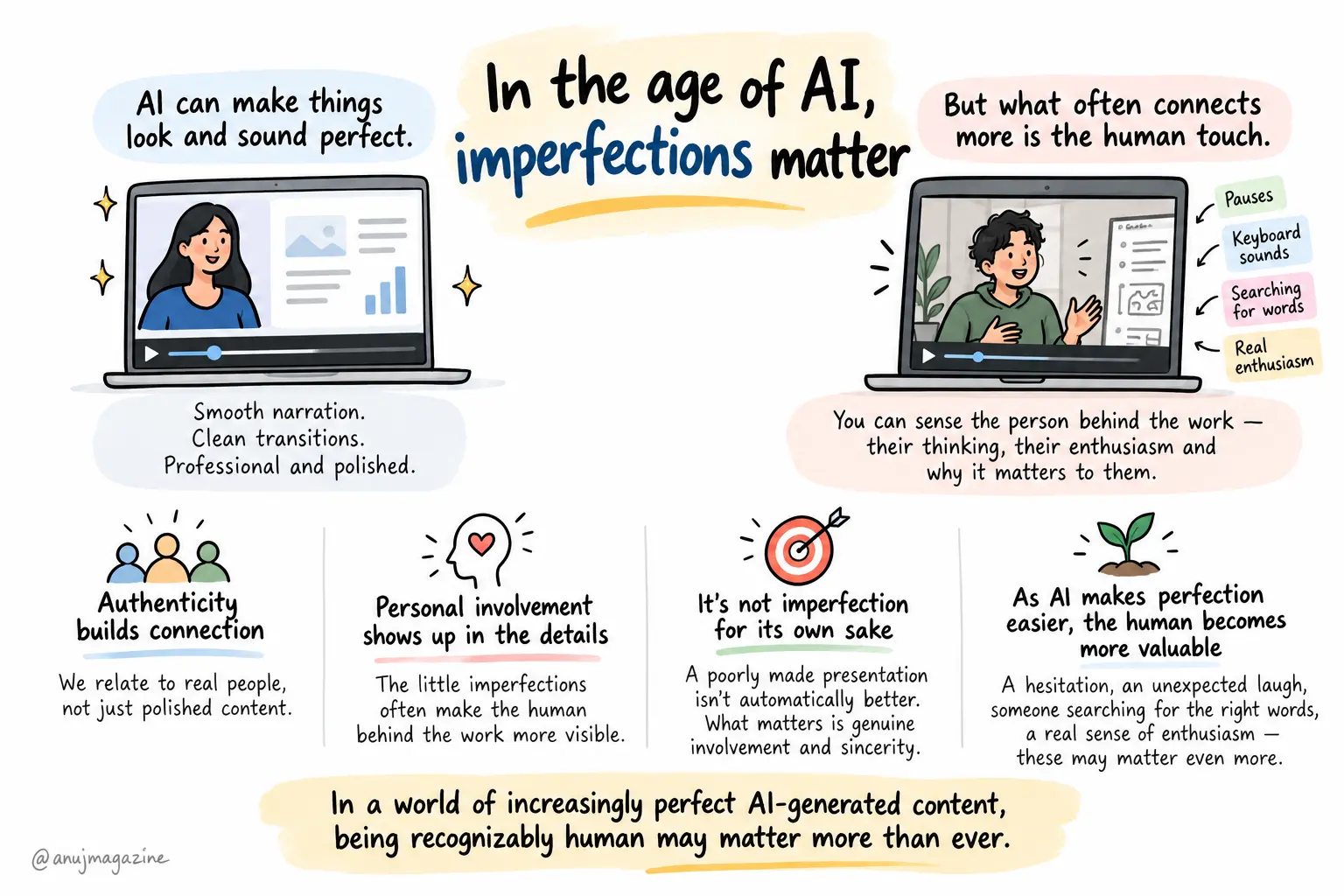
I found myself connecting much more with the ones where students had recorded the demos themselves. These weren’t necessarily the best-produced videos. There were pauses, keyboard sounds in the background, moments when someone struggled to find the right words, and the occasional awkward transition.
But somehow, they felt more engaging.
You could sense the excitement of someone showing something they had built. You could hear them thinking through their explanations. And in some cases, you could see how much the problem they were trying to solve meant to them. The AI-generated videos were often more polished, with smoother narration and better transitions. But quite a few of them didn’t leave the same impression on me.
Of course, this isn’t to say that an imperfect presentation is automatically better, or that AI-generated videos cannot be engaging. What made those student presentations work was the personal involvement that came through. The imperfections simply made that involvement more visible.
For years, we’ve tried to make everything we communicate look and sound more professional. We edit out pauses, remove background noise, rewrite sentences and rehearse until things sound just right. And now AI can help us do much of that almost effortlessly.
As AI makes perfection easier to produce, the small imperfections that make us human may become even more valuable.