AI Civilization: Beyond Smarter Machines
31 August 2026
Noam Brown, a leading research scientist at OpenAI, recently sparked a fascinating conversation about the future of artificial intelligence by introducing the concept of an “AI civilization.”
He appeared on the Latent Space: The AI Engineer Podcast and shared the following:
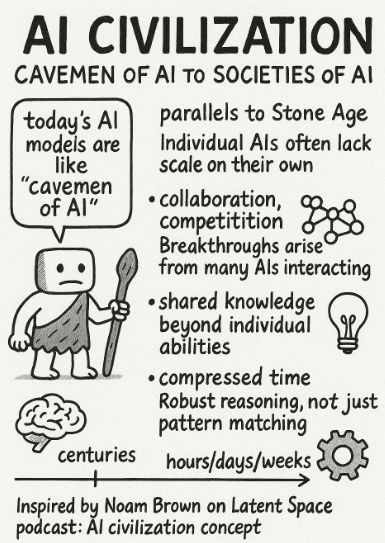
“The AIs that we have today are kind of like the cavemen of AI. And I think that if you’re able to have them cooperate and compete with billions of AIs over a long period of time and build up a civilization, essentially, the things that they would be able to produce and answer would be far beyond what is possible today with the AIs that we have today.”
What would an AI civilization entail?
-
A parallel with human history. Individual humans in the Stone Age couldn’t build rockets or computers. It was through millennia of collaboration, competition and knowledge-sharing that human civilization developed its present capabilities.
-
Societies of AI, not just smarter individual AIs. Brown suggests breakthroughs could come from vast numbers of AI agents interacting, learning from, competing with and helping each other, much as humans do in society.
-
Shared knowledge and joint problem-solving. Just as human civilization advanced through accumulated knowledge, an AI civilization might develop solutions beyond what any single AI could achieve alone.
-
Longer periods of interaction. This could unfold over hours, days or weeks of AI reasoning and interaction, compressing something analogous to long periods of human progress into digital time.
-
Stronger reasoning. Such a system would need robust deliberation and problem-solving abilities, sometimes described as System 2 thinking, rather than relying only on fast pattern matching.
Brown’s AI civilization hypothesis is an interesting lens for thinking about the next era of AI.
It invites us to imagine not just smarter machines, but societies of machines learning, evolving and creating together.
Scary and exciting at the same time.
What do you think?