From AI Models to AI Platforms
24 August 2026
In the world of AI, it is not just the features and models that are changing fast. The underlying narrative is changing just as quickly, and sometimes I find that more interesting than the next model release.
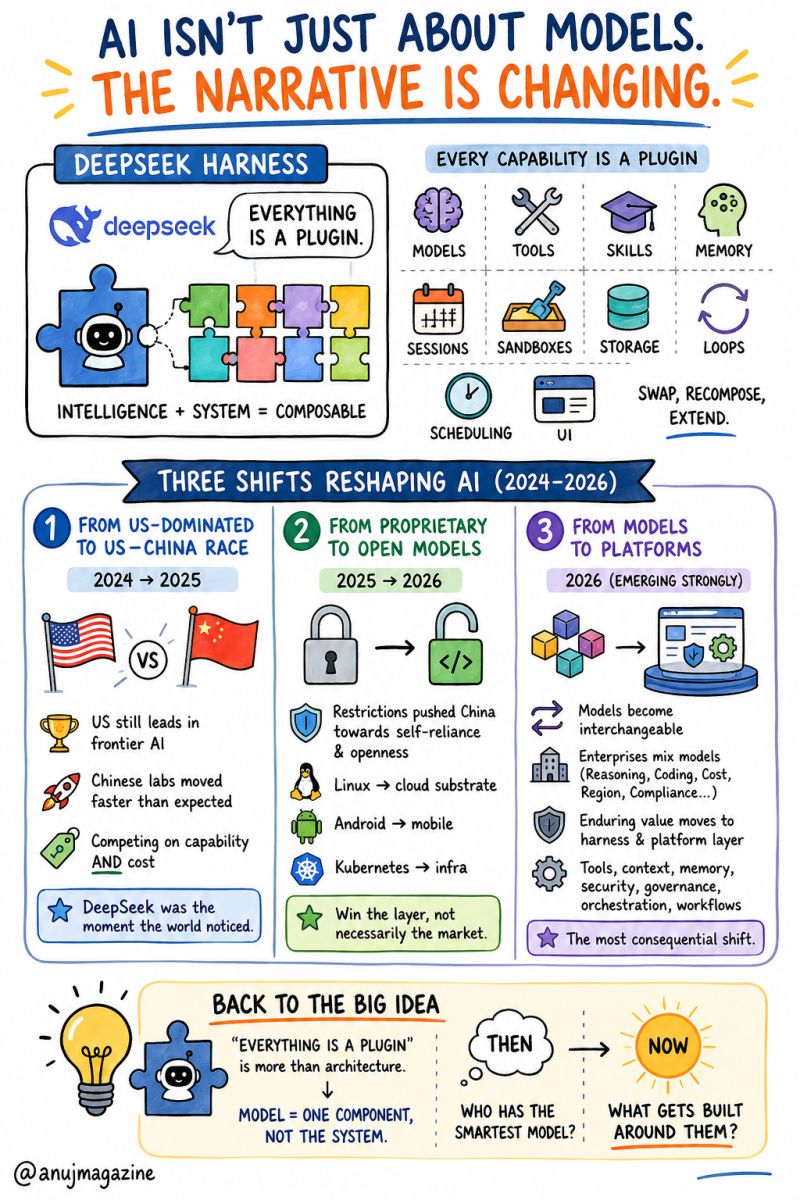
A recent example is DeepSeek Harness, which DeepSeek has built around a rather simple idea:
“Everything is a plugin.”
The model is a plugin. Tools are plugins. Skills, memory, sessions, sandboxes, storage, agent loops, scheduling, even the UI can be swapped or recomposed.
In other words, the intelligence and the system around that intelligence do not necessarily have to come from the same provider.
I found that interesting by itself, and it was something I thought of when I read Jaspreet Bindra’s latest article in The Economic Times, where he steps back from individual announcements and looks at how the larger AI story has changed over the last few years.
He describes three shifts.
1. From a US-dominated race to US-China competition
The first shift, which became visible through 2024 and accelerated into 2025, is from a largely US-dominated model race to a much more competitive US-China race.
The US still has extraordinary strength in frontier AI, but Chinese labs have moved much faster than many expected.
DeepSeek was perhaps the moment when much of the world noticed this. The larger story is that Chinese models are increasingly competing not only on capability, but also on cost.
2. From proprietary models to open models and open weights
The second shift became much clearer across 2025 and into 2026.
This is particularly interesting because attempts to restrict China’s access to advanced technology may have pushed Chinese companies harder towards self-reliance and openness.
Jaspreet makes a nice historical comparison here: Linux became part of the substrate of cloud computing, Android did something similar in mobile, and Kubernetes in cloud infrastructure.
You do not necessarily need to own the entire product market if you become part of the layer on which everyone else builds.
3. From models to platforms
The third shift, now becoming especially visible in 2026, may turn out to be the most consequential one.
If models increasingly become interchangeable, enterprises can choose one for reasoning, another for coding, another for cost, and perhaps another for a specific geography or compliance requirement.
Then the enduring value may move away from the model itself towards the harness and platform around it: tools, context, memory, security, governance, orchestration and workflows that actually allow AI to get work done.
That is quite a change from the AI conversation of just two or three years ago, when almost everything seemed to revolve around who had the smartest model.
The models are still getting better at an astonishing pace. But increasingly, I think the more interesting question is becoming:
What gets built around them?
References