The Next Interface May Be Our Thoughts
8 August 2026
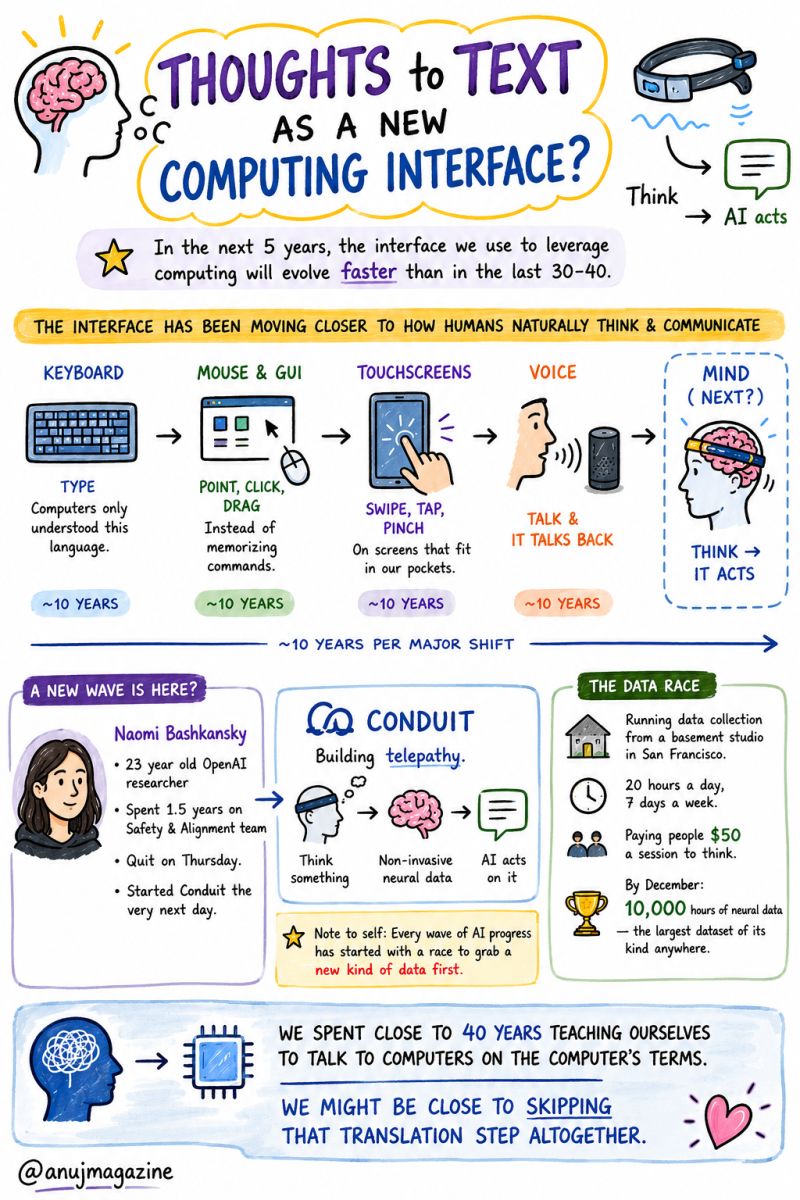
One prediction: the interface we use to interact with computing is going to evolve faster in the next five years than it did in the last thirty or forty.
The reason I believe that is a story I read this week about a 23-year-old OpenAI researcher named Naomi Bashkansky, who spent the last year and a half on the company’s safety and alignment team before quitting this week and starting the very next day at a small startup called Conduit.
Its premise is that they are building telepathy.
I don’t mean that as a metaphor. I mean thought-to-text models trained on non-invasive neural data, where you put on a headband, think something, and the AI acts on it.
How we learned to talk to computers
We started out typing on keyboards because that was the only language computers understood.
Then we got a mouse and a graphical user interface, so we could point, click and drag instead of memorising commands.
Touchscreens came next, and we started swiping, tapping and pinching on a screen small enough to fit in a pocket.
More recently, we started talking to computers, and they started talking back.
Each of those shifts took roughly a decade to move from something researchers were experimenting with in a lab to something an ordinary person does without thinking.
And each one, if you squint, was really the interface moving one step closer to how a human being naturally thinks and communicates, rather than forcing people to think in whatever format the machine could handle.
A new kind of data
Conduit isn’t a big name yet.
It’s a small team, co-founded by Rio Popper and Clem von Stengel, running data collection out of a basement studio in San Francisco: 20 hours a day, seven days a week, paying people $50 a session to sit in a headset and think.
By December, they had reportedly logged 10,000 hours of neural data this way, described as the largest dataset of its kind, academic or corporate.
A note to myself: every wave of AI progress has started with a race to collect a new kind of data first. This looks like the next one.
We spent close to forty years teaching ourselves to talk to computers on the computer’s terms, through keyboards, windows, screens and eventually our own voice.
We might be close to skipping that translation step altogether.
Reference