System One Models: When AI Needs to Decide, Not Chat
21 September 2026
Late last week, the world got introduced to a new type of AI model: System One models. TypeSafe AI’s Jev is presented as the first of its kind, and we experimented a bit with it in the AI&Beyond lab.
First up, System One models exist to fix a specific problem with today’s LLMs.
- ChatGPT, Gemini, Claude and others are built to chat. Prompt them with anything and they write paragraphs of text, even when the answer you actually need is just yes, no or a category.
- That’s fine for a chatbot, but most automated software in a workflow doesn’t need text. It needs a decision it can act on immediately.
- Generating all that extra text costs time and money you didn’t need to spend.
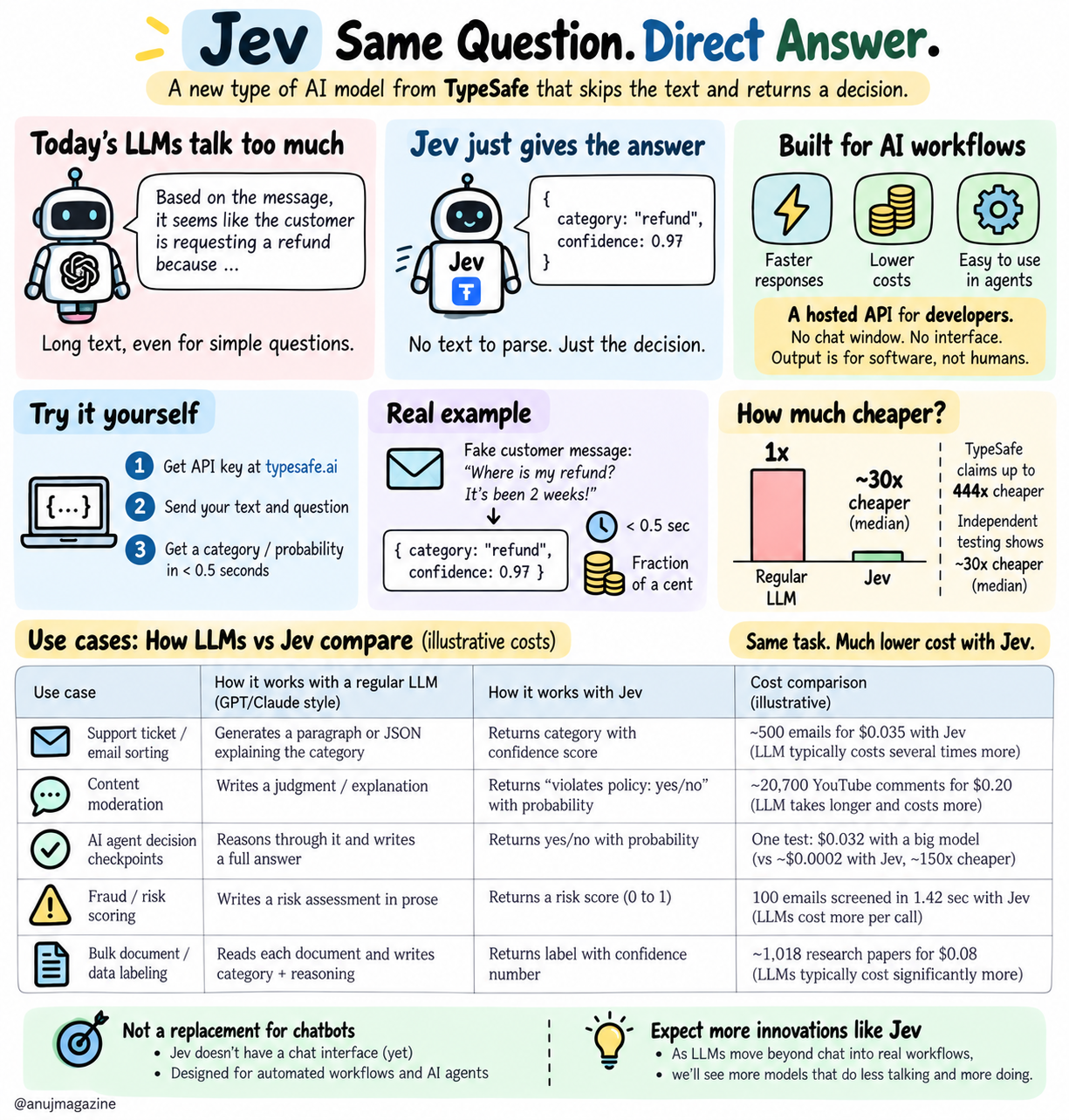
- Jev skips the talking and returns the decision directly: a category or a probability, with nothing lengthy to parse.
We ran a simple test (you need API keys at TypeSafe AI), feeding it a fake customer message and asking one question: Does this person want a refund? It came back with a confidence score in under half a second, for a fraction of a cent.
Scale that to sorting support tickets or screening a thousand documents, and the difference isn’t trivial.
Developers who have run early experiments reported classifying over a thousand papers for eight cents total, and routing an AI agent’s next action for a couple hundredths of a cent instead of paying full LLM prices for what is really just a checkpoint.
These comparisons depend on the models, workloads and assumptions used.
A few things worth noting:
- This is not a replacement for your current chatbot. Jev doesn’t have a chat window or a general-purpose interface that a regular person opens and talks to.
- It’s a hosted API that developers wire into software. The end user typically sees only the result.
- Its output isn’t meant to be read as prose by a human. It returns things like
0.97or{category: "billing"}, useful for AI agents. - TypeSafe claims up to 444 times cheaper than a comparable LLM call. Independent testing cited in early discussions found a median gain closer to 30 times. That is still a meaningful figure, though it is not a universal benchmark.
As LLMs are adopted more widely for automated workflows, their usefulness and limitations are both becoming clearer. Expect to see more innovations like Jev in the time to come.
Why “System One”?
The name comes from Daniel Kahneman’s book Thinking, Fast and Slow, which describes two modes of human thinking:
- System 1: Fast, automatic and intuitive. Like instantly knowing that 2 + 2 = 4 or recognising someone’s face.
- System 2: Slow, deliberate and effortful. Like working out 23 × 47 in your head.
TypeSafe maps this distinction onto AI models:
- Regular LLMs, in this analogy, resemble System 2 when they produce extended reasoning and explanations. That can be powerful, but unnecessary when a workflow needs a quick judgment.
- Jev is designed to resemble System 1: no essay or long reasoning trace, just a fast structured answer such as a score or category.
This is an analogy about the product’s intended role, not a claim that all LLMs literally reason like humans or that every LLM call is slow.
References
- TypeSafe AI: Introducing System One Models and Jev
- TypeSafe AI
- Jev use cases on GitHub
- Cloudraft: Top use cases of Jev