The Hidden Cost of AI: Why Your Next Laptop May Cost More
2 November 2026
The memory chip inside an ordinary laptop now costs roughly ten times what it did two years ago.
I dug up a bit on what’s leading to this rise, and the reason has very little to do with laptops.
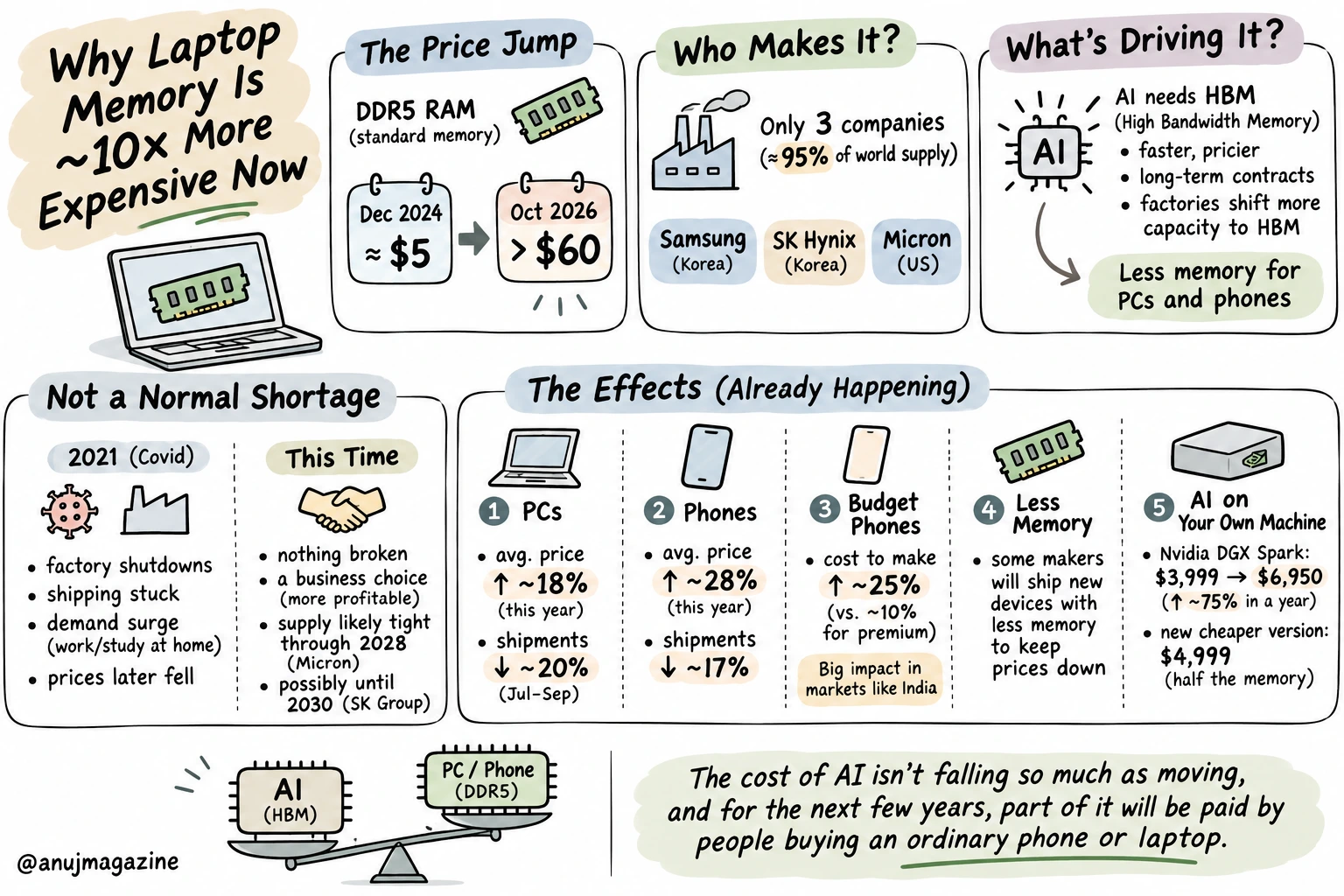
DDR5 is the current standard type of RAM, the short-term working memory a computer uses to hold whatever it is doing right now, and it sits inside most new laptops, desktops and servers. A standard DDR5 chip cost about $5 in December 2024 and over $60 by October 2026, according to TrendForce data.
The memory in your laptop and phone comes from chip factories run by just three companies: Samsung and SK Hynix in South Korea, and Micron in the US. Together they make about 95% of the world’s memory. AI chips need a faster, more expensive type of memory called HBM (High Bandwidth Memory), and AI companies pay more for it and sign long contracts. So these companies are giving more of their factory space to HBM. Both kinds of memory are made in the same factories, so every bit of extra HBM means less memory for PCs and phones. Micron has gone further and stopped selling memory to consumers altogether, saying it wants to focus on its large AI and data centre customers.
This is not a normal shortage.
In 2021, during Covid, factories shut down, shipping got stuck, and at the same time everyone was buying laptops to work and study from home, so chips ran short for a while. Once factories reopened and shipping recovered, prices came back down. This time nothing is broken. It is a business choice, and it keeps getting more profitable. Micron’s CEO expects supply to stay tight through 2028, and SK Group’s chairman has said it could last until 2030.
The effects are already showing up:
- PCs cost more. IDC expects the average PC price to rise about 18% this year, and PC shipments fell 20% in the July to September quarter.
- Phones cost more. IDC expects the average smartphone price to rise about 28% this year, partly because people are moving to pricier models, while shipments drop almost 17%.
- Budget phones are hit hardest. Counterpoint estimates the cost of making a budget phone has risen about 25% because of memory, compared to about 10% for premium phones. That matters in markets like India, where budget phones sell the most.
- Phones and laptops are shipping with less memory. IDC expects some makers to cut the memory in new devices to keep prices down.
- AI on your own machine costs more. Nvidia’s DGX Spark, a small box for running AI at home or in the office, launched at $3,999 and now costs $6,950, about 75% more in a year. Nvidia’s new cheaper version costs $4,999 and has half the memory.
(Note to self: the next time someone tells me AI is getting cheaper, ask which part.)
The cost of AI isn’t falling so much as moving, and for the next few years part of it will be paid by people buying an ordinary phone or laptop who never asked for any of it.
References:
- TechRepublic — PC prices high through 2027
- Implicator — TrendForce memory costs and laptop prices
- Tom’s Hardware — SK Group chairman says memory chip shortage will last until 2030
- The Register — Nvidia debuts $4,999 DGX Spark with half the RAM and storage