The Future of Interfaces: Computers Adapting to Humans
24 October 2026
What will the interface of the future look like in the AI era?
In a recent conversation on the Big Technology Podcast, Google’s CEO Sundar Pichai made an interesting observation:
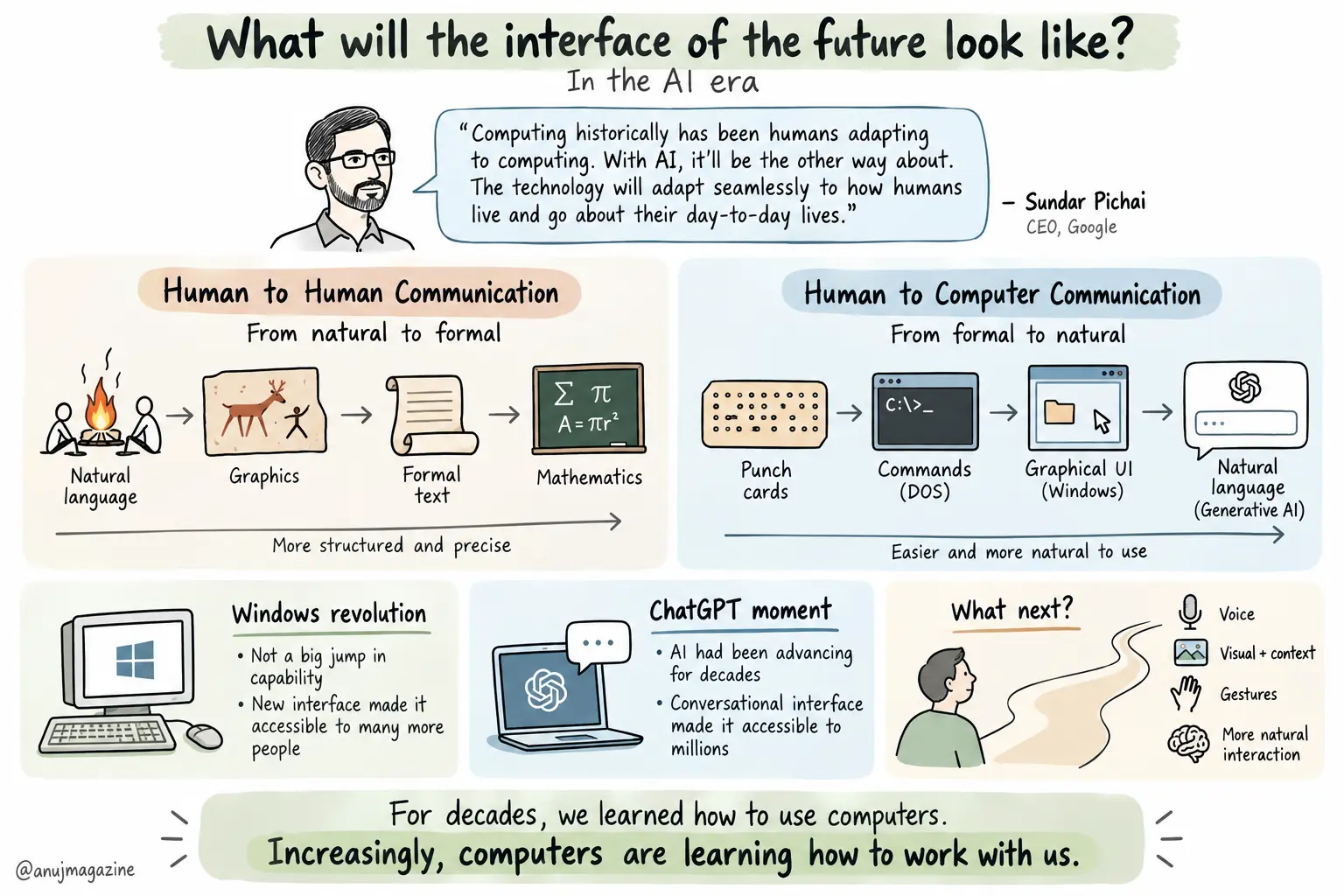
“Computing historically has been humans adapting to computing. With AI, it’ll be the other way about. The technology will adapt seamlessly to how humans live and go about their day-to-day lives.”
I found this a particularly interesting way to think about where software interfaces are headed.
It also reminded me of a fascinating explanation by Dr. Bharat Anand, Professor at Harvard Business School, in a talk at the India Today Conclave.
His argument was that human-to-human communication and human-to-computer communication have evolved in almost opposite directions.
Consider human-to-human communication.
We started with natural language, sitting around campfires and talking to one another. Over time, we developed pictures and symbols, then formal writing through scrolls and books, and eventually highly structured languages such as mathematics.
In a sense, we moved from natural communication towards increasingly formal and precise ways of expressing ideas.
Now consider human-to-computer communication.
We started with punch cards and machine-oriented instructions. Then came command-line interfaces such as DOS, where we had to remember specific commands. Graphical interfaces such as Windows made computers accessible through icons, menus and mouse clicks. And now, with generative AI, we can increasingly communicate with computers in natural language.
The journey has been almost the reverse. We moved from formal, machine-specific instructions towards increasingly natural and intuitive ways of communicating with computers.
The shift from early versions of Windows to graphical interfaces wasn’t primarily about dramatically improving what computers could do. It was about making those capabilities accessible to many more people. AI (starting with ChatGPT) had been advancing for decades, but a simple conversational interface suddenly made it accessible to millions of people who had no specialized technical knowledge.
For decades, we learned how to use computers. Increasingly, computers are—and will be—learning how to work with us.
References:
- Big Technology Podcast — Google CEO Sundar Pichai: AI’s Infinite Possibilities, Compute Scarcity Dilemmas, Future AI Products
- India Today Conclave 2025 — Future.Ai: The New Classroom | Prof. Bharat N. Anand