AI Is Getting Better at Understanding Legacy Software
21 October 2026
AI is getting better at understanding the software we rarely talk about.
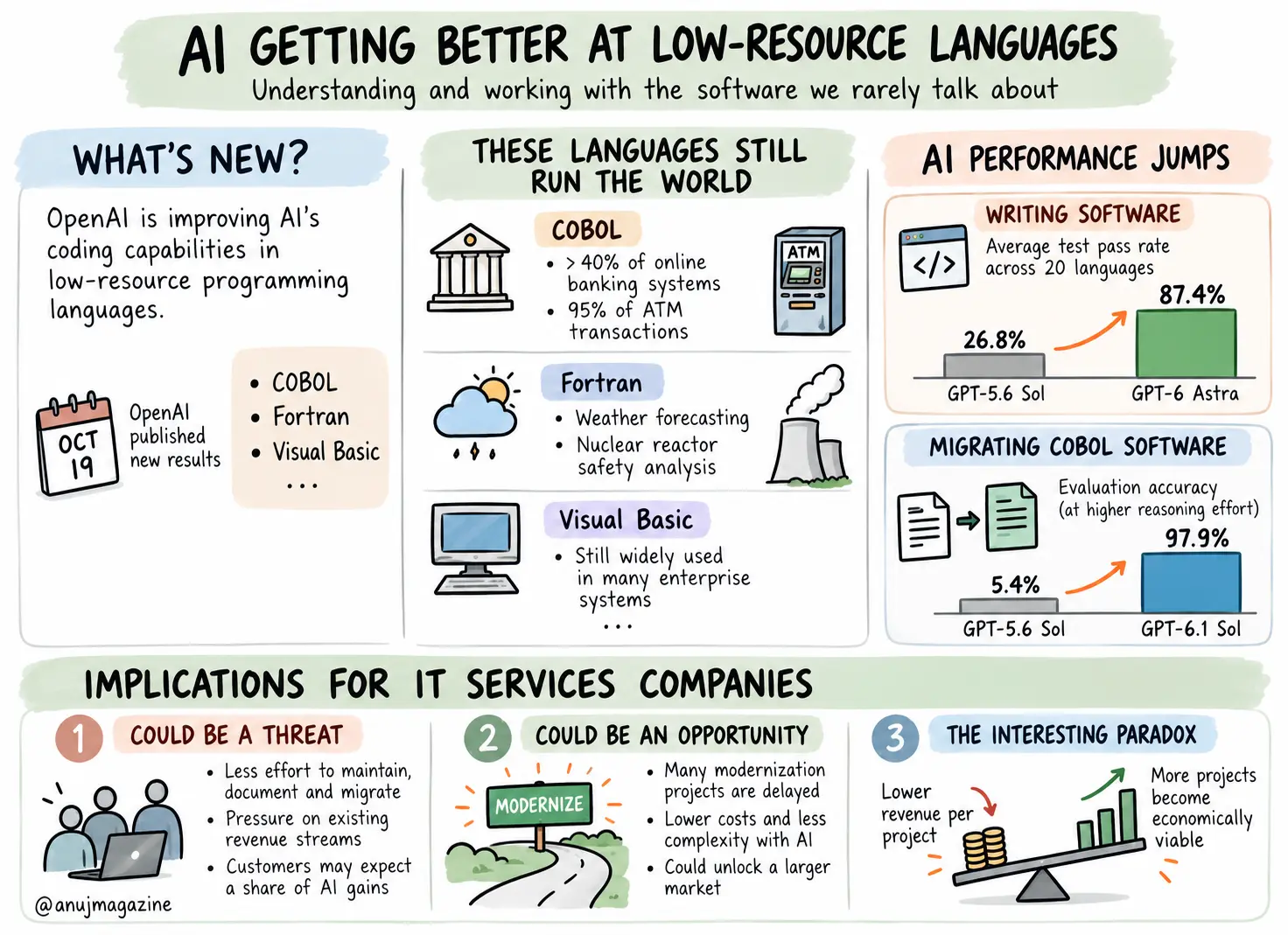
On October 19, OpenAI published an interesting piece on improving AI’s coding capabilities in low-resource programming languages such as COBOL, Fortran and Visual Basic. Fortran happens to be the first programming language I learned.
These languages may not get the attention that Python and JavaScript do, but they continue to run some of the world’s most important systems. For example, OpenAI cites that COBOL supports more than 40% of online banking systems and 95% of ATM transactions. Fortran continues to be used in weather forecasting and nuclear reactor safety analysis.
The problem is that AI models have historically struggled with these languages because relatively little code and documentation is available for training.
OpenAI’s latest evaluations (check the post in comments for benchmark numbers) show considerable progress.
The benchmark results are not necessarily evidence that complex enterprise migrations can now be fully automated. But the improvement seems to be significant.
I see that it has an interesting second-order effect for IT services companies (that have a significant chunk of COBOL and Fortran projects).
On one hand, AI could reduce the effort required to maintain, document and migrate legacy software. For IT services companies that depend on large teams and effort-based billing, this could put pressure on existing revenue streams as customers would expect them to pass on the AI gains back to them.
On the other hand, many enterprises have postponed legacy modernization because of high costs, complexity and a shortage of specialized skills. If AI brings down these barriers, it could unlock a much larger market for modernization projects.
Interesting space to watch out for.
Reference: OpenAI — Improving AI’s coding capabilities in low-resource programming languages