AI Is Changing the Software Development Workflow
19 August 2026
I was reading through my news feed this morning and came across a story about Cursor launching something called Origin.
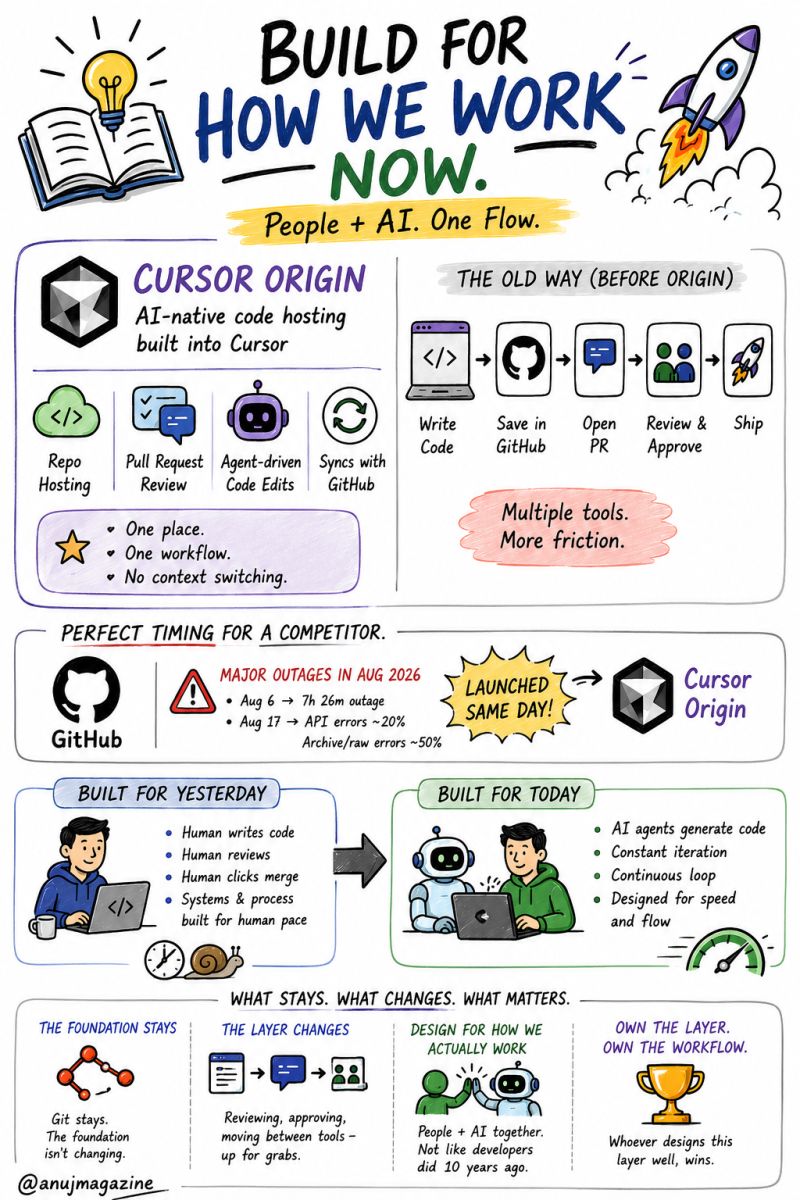
Cursor Origin is described as an AI-native code hosting platform built into the Cursor editor. It brings repository hosting, pull request review and agent-driven code edits into one integrated workflow.
Until now, if you were coding with Cursor, you would write the code there but then hop over to GitHub to save it, track changes, open a pull request and get it reviewed by a teammate before it goes live.
Origin aims to collapse those steps into one place, so writing, AI agent edits, human review and approval can happen without switching tools. It also syncs with GitHub in the background.
So is it a GitHub competitor?
Absolutely.
An interesting coincidence
Origin’s launch coincided with a major GitHub outage.
GitHub reportedly experienced two major disruptions within eleven days in August 2026: one on August 6 lasting 7 hours and 26 minutes, and another on August 17 that pushed API error rates to around 20%, with archive and raw-content error rates reaching around 50%.
Nobody planned that collision, but it’s hard to write a better advertisement for a competitor than your own product falling over on launch day.
The bigger shift is in workflow design
In all this, there’s an angle I find particularly interesting: the newer factors software products need to consider in their design.
GitHub was built for a world where a human writes code, a human reviews it and a human clicks merge. That assumption is reflected in how its review processes and interfaces work.
Cursor is betting that once AI agents generate a large share of the code and iterate on it constantly, the old rhythm of writing somewhere, saving somewhere else and reviewing in a third place begins to feel like unnecessary friction.
The product that wins may be the one designed around a faster, more continuous loop from the start, rather than one retrofitting AI onto a system built for a slower, more human-paced workflow.
I don’t think this means every piece of software needs to be torn down and rebuilt.
Git itself, the technology underneath both platforms, isn’t changing.
But the layer people actually touch, reviewing, approving and moving between tools, is genuinely up for grabs.
Whoever designs that layer for how people and AI actually work together, instead of how developers worked ten years ago, may end up owning the workflow.
References
- ExplainX: Cursor Origin code hosting and GitHub outage, August 2026
- IncidentHub: GitHub Actions and Pages outage, August 6, 2026