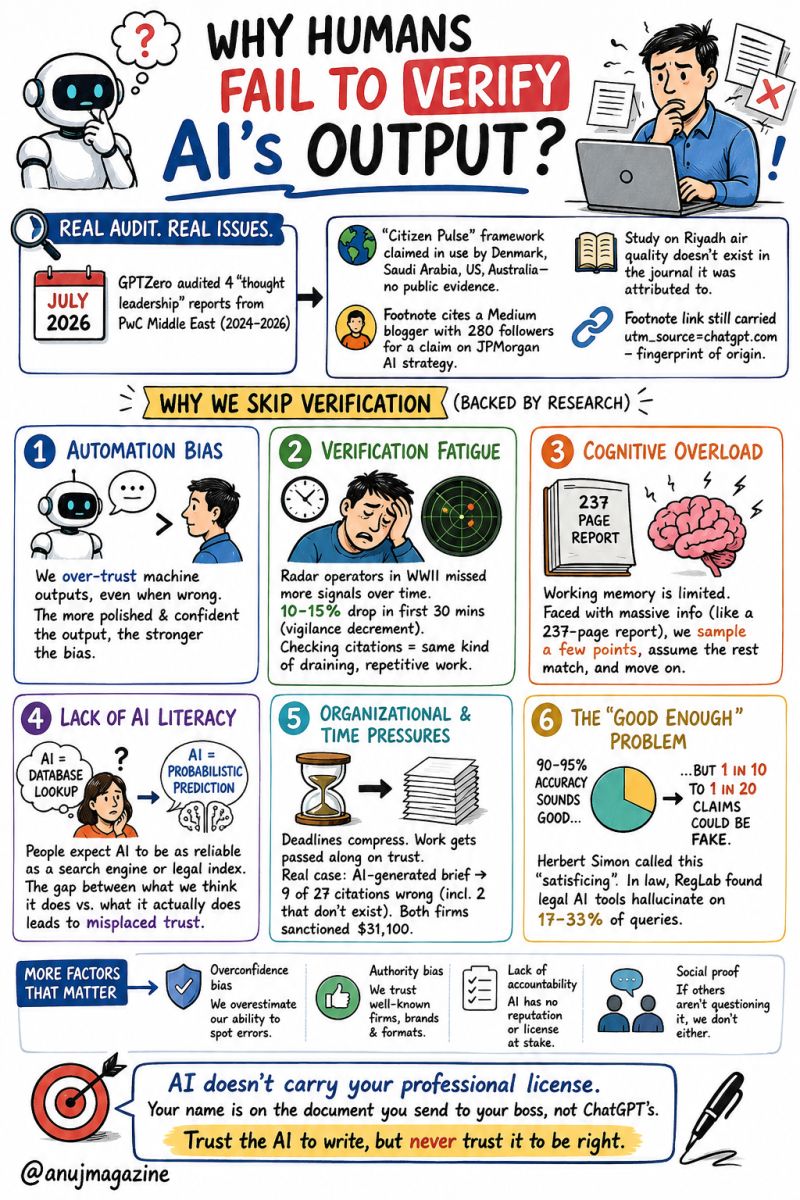
Why Humans Fail to Verify AI's Output
5 August 2026
In July 2026, AI-detection firm GPTZero ran an audit on four “thought leadership” reports from PwC Middle East, published between 2024 and 2026.
What they found:
- A footnote citing a Medium blogger with 280 followers as the source for a claim about JPMorgan’s AI strategy.
- A study on Riyadh air quality that doesn’t appear to exist in the journal it was attributed to.
- One footnote link still carrying the parameter
utm_source=chatgpt.com, a literal fingerprint of where the content came from.
It spins my mind why we wouldn’t be extra cautious presenting AI-generated research, especially in high-stakes situations.
So I spoke to a few learned friends, brainstormed with AI on the reasons, and dug into the research behind each. A few reasons:
1. Automation bias
This has a name in psychology, and it’s not new. Parasuraman and Riley’s 1997 study on human-automation interaction found people systematically favor a machine’s recommendation over their own judgment, even when contradicting evidence is right in front of them.
2. Verification fatigue
Also documented, going back to WWII. The Royal Air Force commissioned psychologist Norman Mackworth to find out why radar operators kept missing enemy U-boat signals.
His finding: trained observers watching for rare events showed a measurable decline in detection, 10–15% within the first 30 minutes alone, continuing to slide from there. He called it the vigilance decrement.
3. Cognitive overload
Related, but distinct. Cognitive Load Theory, developed by educational psychologist John Sweller in 1988, explains that working memory can only hold a limited amount at once.
4. Lack of understanding of how LLMs work
Academic reviews of how laypeople perceive AI chatbots consistently find the same gap: people conflate generative, probabilistic text prediction with database lookup, expecting the same reliability from a language model that they’d expect from a legal citation index or a search engine.
5. Organizational and time pressures
Not hypothetical. Earlier this year, an attorney at Ellis George built an AI-generated outline for a brief and shared it with colleagues at K&L Gates without flagging its AI origin or verifying it.
Nine of the 27 citations in the final filing turned out to be wrong, including two cases that don’t exist. Both firms were sanctioned $31,100.
6. The “good enough” problem
Nobel laureate Herbert Simon called this satisficing: settling for “good enough” because verifying everything is expensive.
What else do you think would add to this?
AI doesn’t carry your professional license. Your name is on the document you send to your boss, not ChatGPT’s.
So trust the AI to write, but never trust it to be right.
The gap between what people assume AI is doing and what it’s actually doing is exactly why AI literacy isn’t optional anymore.
References and Further Reading
- GPTZero: Investigation of PwC reports
- Fortune: Deloitte AI-generated report and refund
- Damien Charlotin: AI hallucinations in legal filings
- Parasuraman and Riley (1997): Humans and Automation
- Mackworth Clock and vigilance research
- John Sweller (1988): Cognitive Load During Problem Solving
- Stanford: Legal RAG Hallucinations
- Law.com: Ellis George and K&L Gates sanctions