The Shirt That Fooled AI Cameras
14 September 2026
There was a genuinely interesting piece of news a few days back: a designer in Berlin figured out how to cheat AI cameras, and he did it with a shirt.
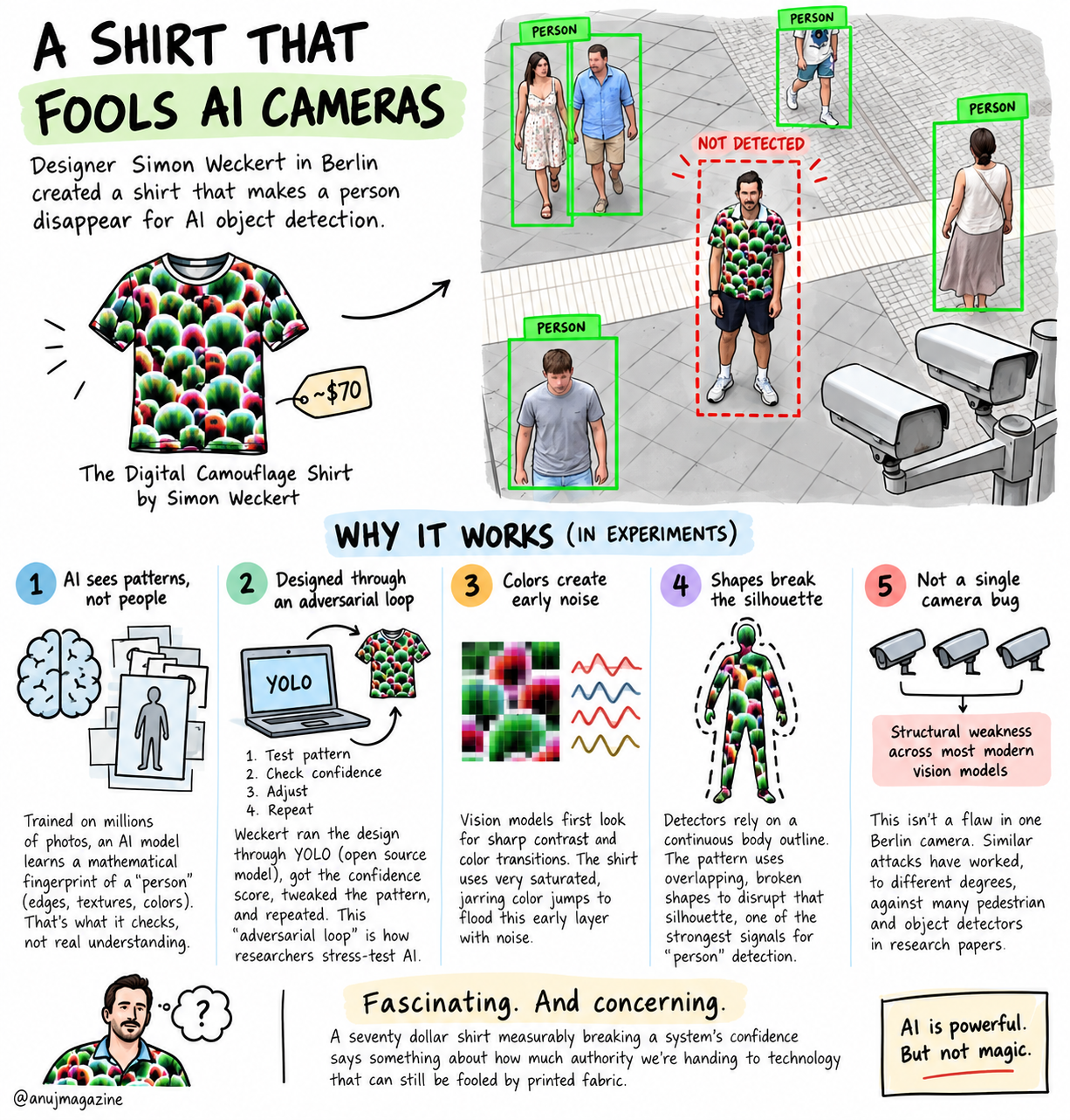
Simon Weckert built something called the Digital Camouflage shirt. Its pattern is designed to make a person wearing it harder for an AI object detection system to recognise as a person.
A printed fabric confusing a vision model!
I read up a bit about what went into the shirt’s design and why it worked, at least in experiments.
-
What the model sees. An AI detector doesn’t see a person the way we do. It learns statistical patterns from training images, including edges, textures, colours and shapes. It uses those learned signals to estimate whether an image contains a person, rather than understanding a human being in the way we do.
-
An adversarial loop. Weckert tested patterns against YOLO, an open-source object detection model, checked the confidence score for the person detection, adjusted the pattern and tested again. He calls this an adversarial loop. It resembles how researchers stress-test vision models more than how someone normally designs a shirt.
-
Why the colours matter. Strong contrasts and abrupt colour changes can interfere with the visual features a detector relies on. The shirt uses saturated, jarring patterns to make the model’s task harder.
-
Why the shapes matter. Overlapping and broken shapes can disrupt visual cues associated with the outline of a person. That may reduce a detector’s confidence in recognising the wearer.
-
The wider lesson. Adversarial clothing is not unique to one camera or one model. Researchers have demonstrated related attacks against pedestrian and object detectors, although results vary with the model, camera, environment and viewing angle.
Fascinating and concerning at the same time.
A roughly seventy-dollar shirt reducing a system’s confidence in experiments says something about how much authority we’re handing to technology that can still be fooled by printed fabric.
References