The Laptop Is Being Reimagined Around AI
25 September 2026
AI is starting to reimagine something that hadn’t really changed in decades: the laptop itself.
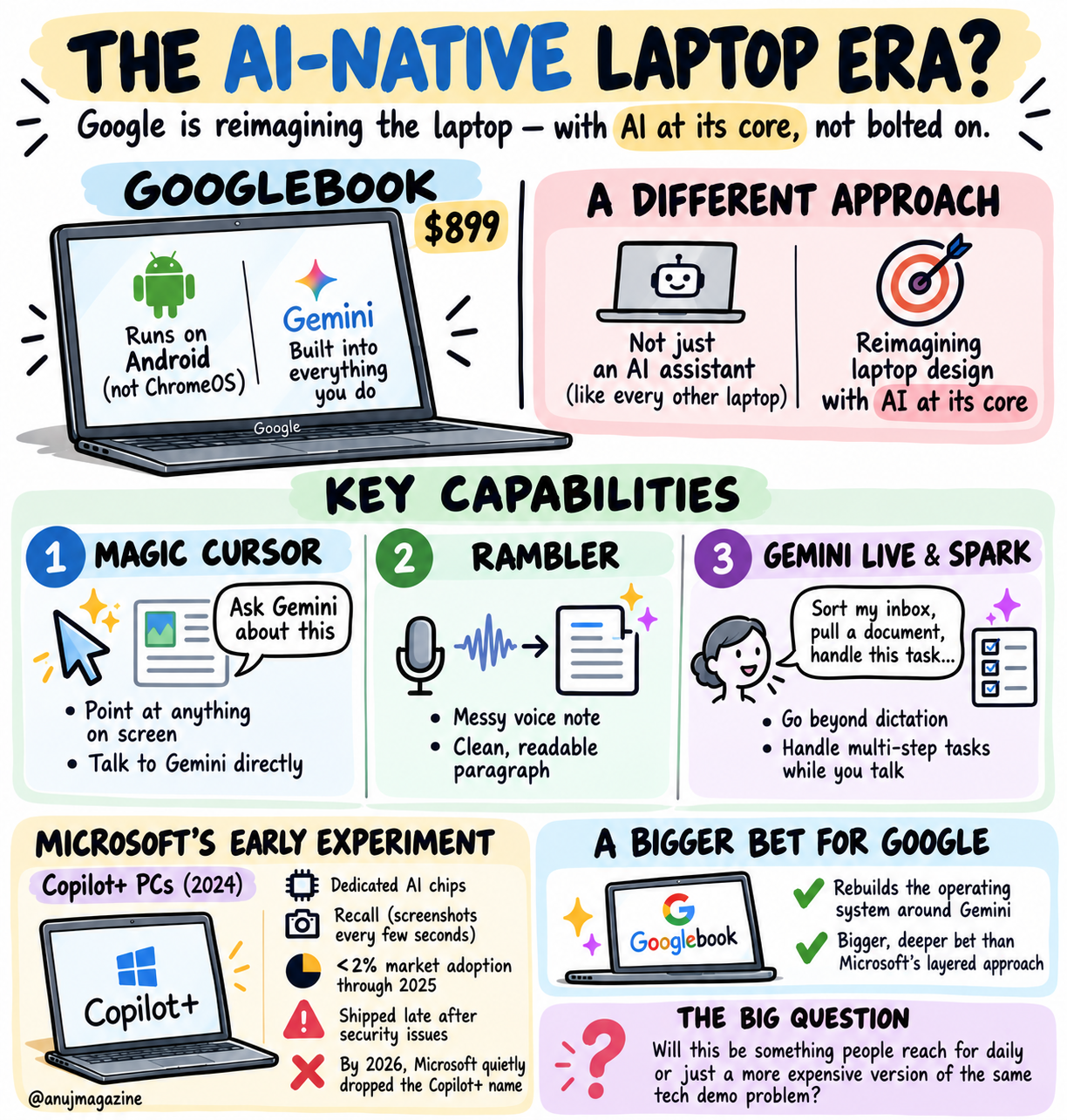
Google recently launched the Googlebook, a $899 laptop that runs on Android rather than ChromeOS, with Gemini sitting underneath almost everything you touch on screen rather than living inside a browser tab.
The driving concept here is different. It’s not an AI assistant on the laptop; every laptop has one of those now. It’s about where the AI lives. It’s about reimagining laptop design with AI at its core.
A few capabilities make this concrete:
- Magic Cursor turns your regular pointer into a way to talk to Gemini directly. Point at an image or a block of text anywhere on screen and ask about it, without first copying it into a separate chat window.
- Rambler is a dictation tool. It takes a messy voice note and cleans it into a readable paragraph on its own.
- Gemini Live and Gemini Spark go beyond dictation. You can ask the machine to sort your inbox, pull together a document, or handle a multi-step task while you talk it through out loud.
None of this is dramatic if looked at in isolation. But stacked together, it’s a bet that the point-and-click interface we have used for forty years needs to be rebuilt around AI rather than have AI bolted onto the side of it.
Microsoft already ran a version of this experiment. Copilot+ PCs launched in 2024 with a similar pitch: dedicated AI chips and a flagship feature called Recall built into Windows itself. Recall, controversially, captures snapshots of what appears on your screen as you work.
Adoption reportedly barely crossed 2% of the PC market through 2025. Recall shipped late after security researchers identified serious concerns, and by 2026 Microsoft and some hardware partners had moved away from prominently using the Copilot+ name in marketing, even though the machines still met the same technical specifications. The experience has struggled to earn the trust it needed.
Google is making a structurally bigger bet than Microsoft did: rebuilding the operating system around Gemini rather than layering an assistant on top of Windows. Whether that produces something people reach for daily, or just a more expensive version of the same tech-demo problem, is still wide open.
Reference