Humans and AI: A Different Division of Labour
6 October 2026
Recently, Anthropic published an article on how it made its chat app faster. Beyond the technical details, it’s an interesting case study of how humans and AI worked together.
Some of my notes below:
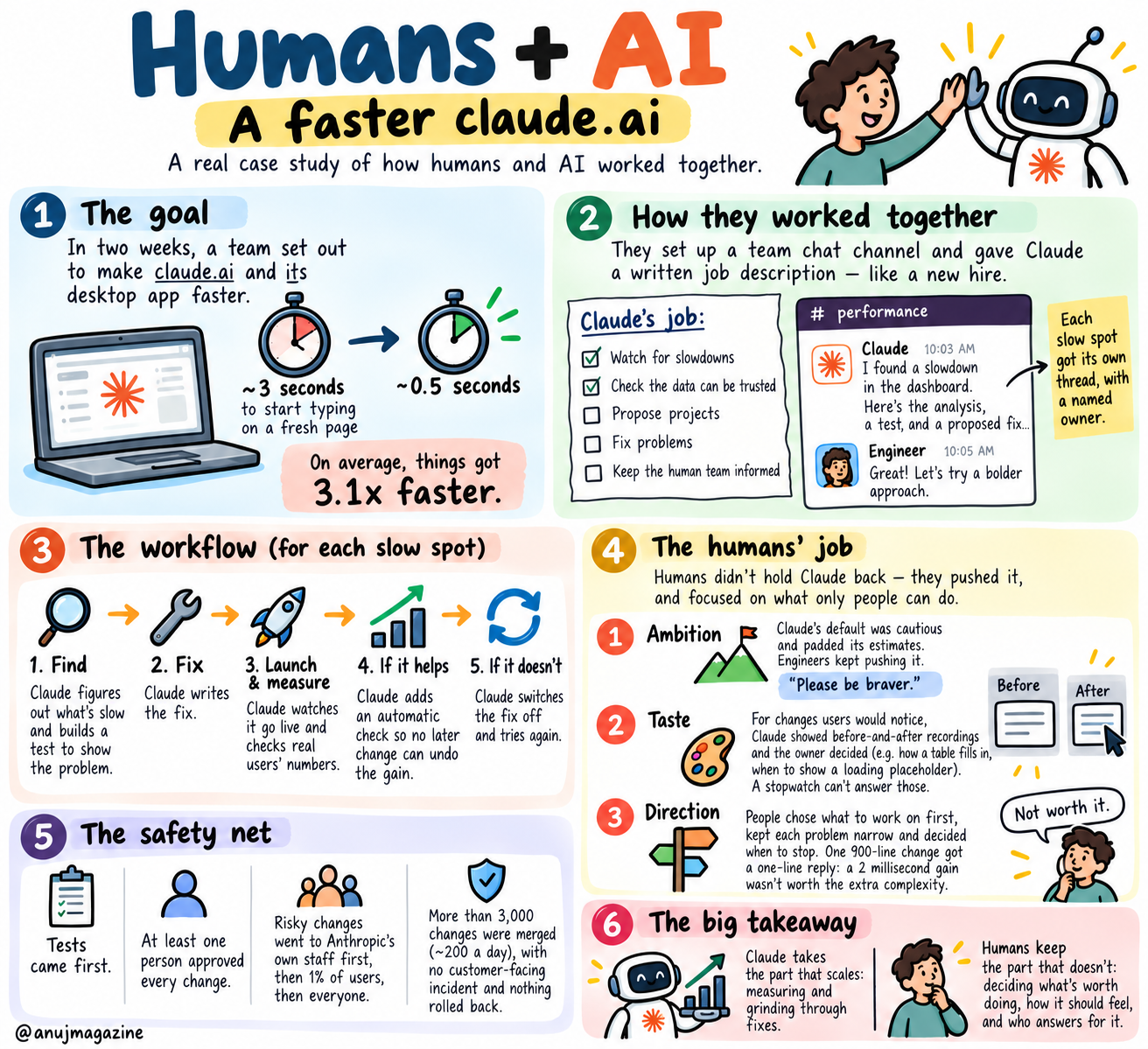
Over two weeks, a team set out to speed up claude.ai and its desktop app. The wait to start typing on a fresh page load dropped from about 3 seconds to about half a second, and on average things got 3.1 times faster. Claude did the hands-on work.
How did the team work with Claude?
The team made a channel in its team chat and gave Claude a written job description, the way you would for a new hire. It said to watch for slowdowns, check the data can be trusted, propose projects, fix problems and keep the human team informed. Each slow spot got its own thread in the channel, with a named person as owner.
More precisely: someone flags a slow screen. Claude works out what’s slow and builds a test that shows the problem. Then it writes the fix, watches it go live and checks real users’ numbers. If it helped, Claude adds an automatic check so no later change can undo the gain. If not, it switches the fix off and tries again.
The humans’ job had three parts
- Ambition. You might expect humans to hold an AI back. Here, Claude’s default was caution: it hedged and padded its estimates. So the engineers kept pushing it, with messages like “please be braver.”
- Taste. For changes users would notice, Claude showed before-and-after recordings and the owner decided. Should a table fill in one cell at a time? Should a loading placeholder show at once, or after half a second? A stopwatch can’t answer those.
- Direction. People chose what to work on first, kept each problem narrow and decided when to stop. One 900-line change got a one-line reply: a 2 millisecond gain wasn’t worth the extra complexity.
What was the safety net?
- Tests came first.
- At least one person approved every change.
- Risky changes went to Anthropic’s own staff first, then 1% of users, then everyone.
- More than 3,000 changes were merged, about 200 a day, with no customer-facing incident and nothing rolled back.
Claude took the part that scales: measuring, and grinding through fixes. Humans kept the part that doesn’t: deciding what’s worth doing, how it should feel, and who answers for it.
References