Drawing Is Thinking
25 July 2026
In his October 2024 blog, Write and Write-Nots, Paul Graham talks about the impact of AI on writing:
“(with AI) Almost all pressure to write has dissipated. You can have AI do it for you, both in school and at work.
The result will be a world divided into writes and write-nots. There will still be some people who can write.”
Writing as a thinking tool will continue to exist, but increasingly few people may practice it.
Will the act of drawing as a means to communicate also follow the same path? A few thoughts come to mind:
-
Drawing as a cognitive tool will persist, particularly in fields where visual thinking is essential for problem-solving and innovation. The act of sketching — quick, rough, iterative — remains deeply intertwined with human thought processes.
-
The divide between “draws” and “draw-nots” may be less stark than with writing, as basic sketching remains valuable for spatial reasoning and rapid ideation in ways that AI-generated images do not (as yet) fully replace.
-
The future may see a hybrid approach — and it is already happening. Quick human sketches can serve as inputs for AI refinement, preserving the cognitive benefits of drawing while using AI for polished execution.
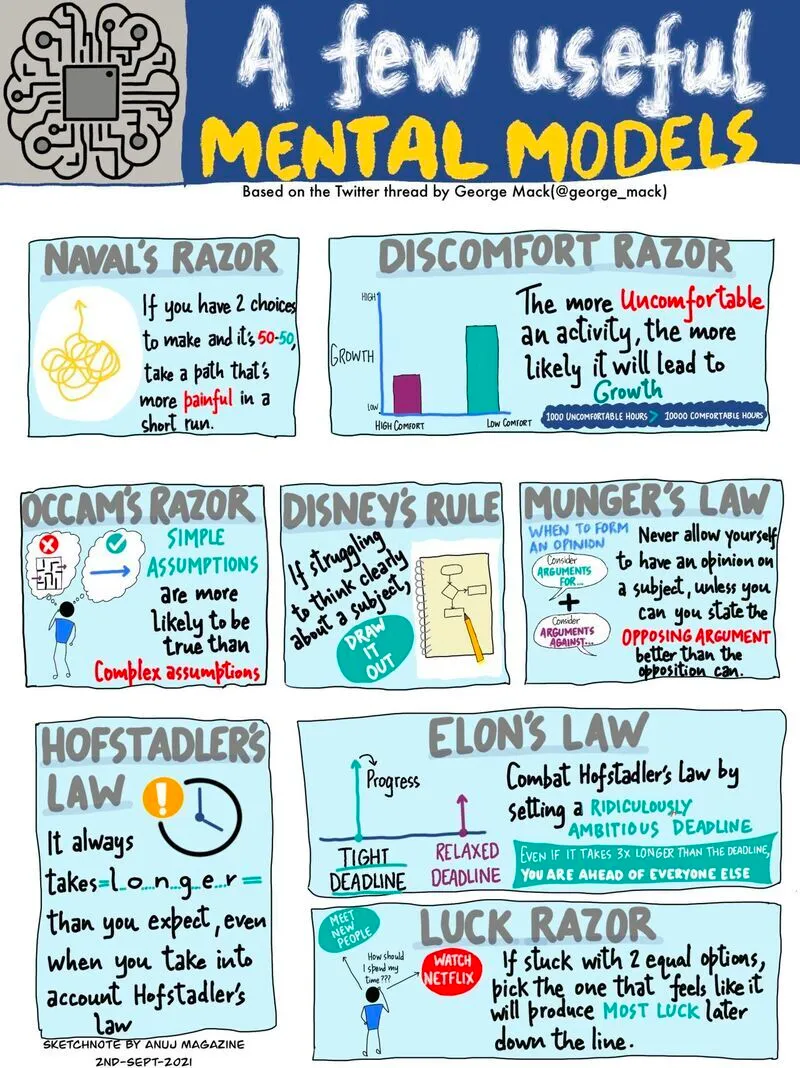
I share here a popular sketchnote of mine that references some useful mental models.
Do check Walt Disney’s Rule, which suggests that if you’re struggling to think clearly about a subject, draw it out. Before Disney built his media empire, he had it drawn out first in his head and then diligently on paper. Read more.
Drawing as a means to bring clarity is an effective yet underrated tool. Drawing ideas helps you slow down and think things through before taking on mighty problems.
What was the last project you worked on where a simple drawing paved the way forward?
References and further reading: